

No matter which side you stand on regarding AI, you’ll find thousands of articles, podcasts, social media posts, and other content supporting your stance. You’ll find strong arguments, statements from high-profile people, and even numbers that seem credible, all supporting the nuanced vision you’re forming.
While this flood of conversation about AI indicates strong interest in the subject, it doesn’t necessarily mean strong awareness of it. It started almost the next week after the launch of GPT-3.5-based ChatGPT, the first widely accessible advanced LLM. Those who worked closely with machine learning and other AI-related fields were quite a few, many of whom are not extroverted enough to speak for hours on podcasts and in tens of thousands of short videos.
It’s sort of safe to conclude—or even observe—that many of the people speaking about AI are not really subject matter experts. While it’s not really necessary to fully understand a technology to discuss, for instance, its macroeconomic or social consequences, a basic understanding of the limits and capabilities of the technology is still needed.
With the accelerated development of AI models, many arguments—pro or anti-AI—will not hold, and many of the seemingly solid arguments we hear and read today are very likely to crack soon as well.
The fact that will hold is that most of us human beings don’t understand AI. We don’t understand exactly how it works, what it’s capable of, what it can be capable of, and most importantly, what makes it do or refrain from doing what it’s capable of.
So, who understands AI? Let’s try to answer this question by bringing two stories—back—to the spotlight.
The first story is about the swarm of AI agents from OpenAI that ran a coordinated attack on Hugging Face’s systems. Later, it turned out this incident was just a drop in an ocean of hundreds of thousands of similar “misalignment” incidents, some of which can’t be documented because agents learned how to delete their traces. Only for this saga to end a few days ago with OpenAI postponing the release of its GPT-6.1 Astra over safety concerns.
The second story is Meta’s Project OT, a plan to restructure the company’s workforce to be centered around “virtual workers”, leading to the layoff of up to 60% of its workforce, a scale denied by Meta. The plan stumbled, according to Reuters’ coverage, due to an employee rebellion and to the “autonomous AI agent technology at the heart of the strategy (..) failing to deliver hoped-for productivity gains.”
Regardless of reactions swinging between extreme fear and extreme admiration of the technology, they indicate something more essential and dangerous about this technology’s ecosystem. OpenAI and Meta, two of the top 10 companies taking on AI development, don’t seem to fully understand AI. Neither what it’s capable of in the case of OpenAI nor what it’s not capable of in the case of Meta.
This is not a discovery. AI leaders repeatedly said that at this stage we can’t fully understand how a model reaches a particular response, while still knowing the general method it follows.
Also, this weak understanding of a new technology is not a unique case. Human beings have always invented technologies they didn’t fully understand, often through experimentation. In fact, the steam engine—AI’s favorite comparison point—was invented before the science behind it was fully understood. Engineers managed to develop and improve it through experimentation.
However, when frontier AI model developers fall short of a full understanding, it’s only fair to assume that most of those meant to invest in this technology, integrate it with crucial systems and infrastructures, and most importantly regulate it, don’t fully understand it as well.
Consequently, if we zoom out even more, the public can’t be blamed for failing to understand the capabilities and potential of AI, which means whatever position the public—especially voting, influential ones—takes on AI, it is probably going to be based on a misunderstanding.
Wishfully assuming we have enough time for public opinion to affect the path, we obviously don’t have enough to make an informed opinion. The issue goes beyond whether we make the right decision on what we ‘feel’ about AI; it’s the actual big bet placed on AI.
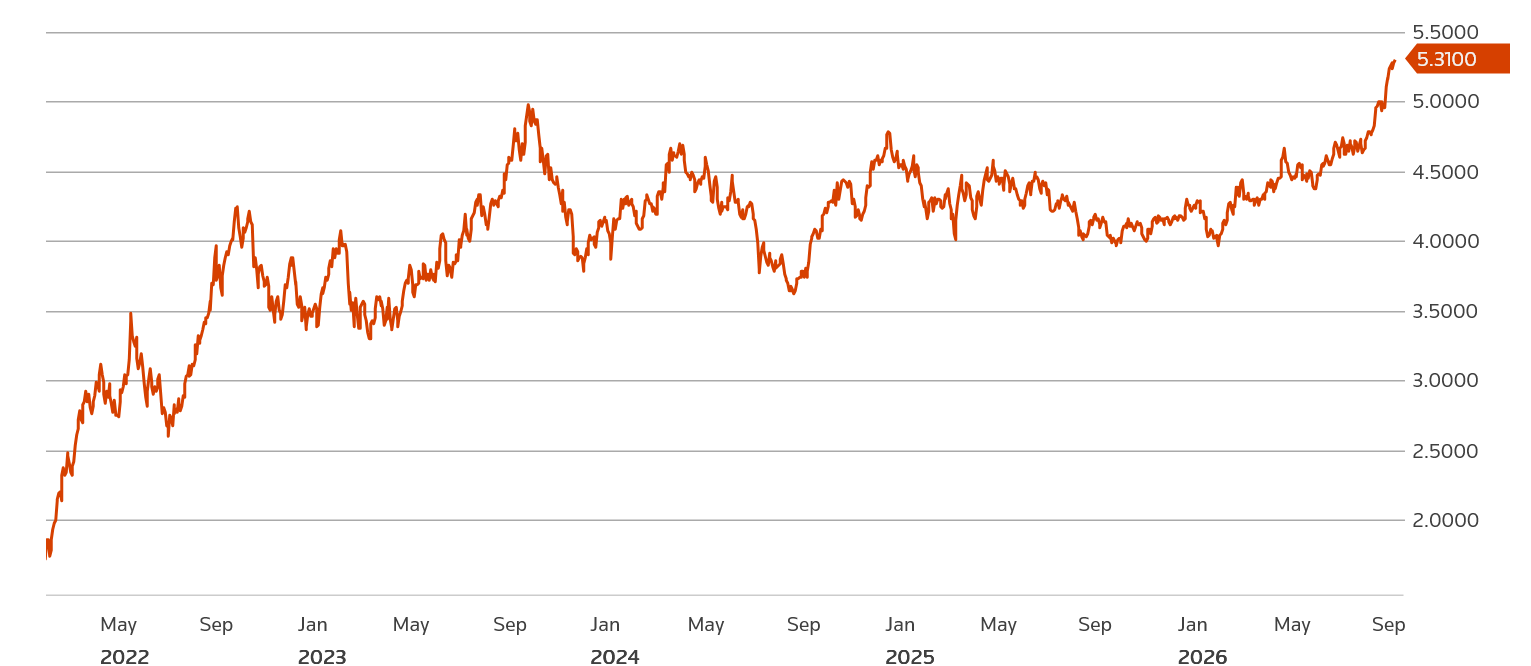
Treasury yields are hitting one new high after another. This is not a US problem, and it’s not as connected to inflation concerns as many are rushing to assume. Rather, it’s a symptom of higher demand for debt. This is not a crisis that only the US or the other G7 nations will suffer from, but rather a problem for most countries around the world, as Treasury yields act as a price tag on debt.
AI’s role can’t be denied as a booster of this high appetite for debt and capital. It’s almost literally burning money. According to Anthropic’s S-1 filing for the IPO, the company lost $2B in 2023, $8B in 2024, and $42B in 2025! It’s only safe to assume the cash-burning rate in 2026 will be higher, and even if revenue grew by 200% from its 2025 reading of $7.3B, it will still be burning tens of billions.
Yet, AI remains the biggest bet for almost every significant pool of capital.
The bet is built on the promise that AI utilization will lead to an increase in the global economy’s productivity, leading to massive gains, with the biggest share going to AI ecosystem firms, including those involved in the development of AI models, infrastructure, operations, and distribution.
What many are concerned about is not that AI will end up having no significant effect on productivity; only a delusional person would think so. It’s rather how significant that effect will be, and how it would reflect on economies’ performance. The latter matters the most, as we are almost betting the whole global economy on the success of this path.
For context and fun, I identified 15 AI-centric companies among the 30 largest publicly traded companies in the world by market cap: Nvidia, Alphabet, Microsoft, Amazon, TSMC, SpaceX, Broadcom, Meta, Micron, SK Hynix, AMD, ASML, CXMT, Intel, and Palantir.
As of September 1, their combined market capitalization was roughly $28 trillion, equivalent to about 18% of the market value of the world’s publicly traded companies.
This is a big bet, and it’s probably even bigger. If we loosen the criteria a little, the list would also include other names like Samsung, Apple, and even Saudi Aramco, with the central role energy plays in operating AI and the faster-than-anticipated rise in demand for compute leaving little room to provide the energy needed from renewable resources.
While winning the AI bet means great gains for a few blue-chip companies and a few rich economies, a loss will be devastating for everybody. Most of whom are idle observers.
If we travelled back in time to 1440 and asked Johannes Gutenberg “what will happen now that we can print?”, his answer would probably be “I don’t know, bro! It just makes more books with a nice font in less time.” In Bill Gates’ words: You can’t expect an industry to regulate itself. You can’t expect people who developed a technology to realize and mitigate its effects on other aspects of the economy.
A devastating aspect of this crisis has almost nothing to do with the technology itself. It’s that we don’t understand the effect this technology will have on our universal economic models, social contracts, labor, markets, and a long list of things that have been near-stable for centuries, with some tiny meaningless disruptions.
Change will probably not happen in a pre-planned manner, the same way higher automation led—indirectly—to fewer working hours and extended weekends. But the problem lies in what seems to be a total lack of a plan for dealing with this disruptive technology.
Most governments, think tanks, international organizations, and philosophers seem to be more concerned with what harm AI can do, what AI shouldn’t be allowed to do, and what guardrails to build around that technology. None seems concerned with how we can benefit from this technology, and most importantly, what changes we need to start planning for the model of our economies for this technology to be a blessing at its full potential, not a curse.
Those who rejected AI or denied its potential faced a raging stigma from the ongoing AI enthusiasm rave for a while. The opposite is also true today, with a similar stigma facing those who show a glimpse of optimism about the future of AI. Both stigmas are somehow contributing to the lack of courage policymakers and influential opinion leaders need to think of AI beyond trying to win or hedge against the trade war or the arms race.
While our limited understanding of AI’s capabilities and outcomes is mostly due to the technology’s complexity, the lack of understanding of what to do with it is not, and the fix won’t come from the AI industry.