


It felt a bit surreal to see Sam Altman and Dario Amodei addressing the UN Security Council on the “imminent” risks of AI. After years of assuring the world this technology will only bring good things, frontier AI companies seem to suddenly change direction and become pro-regulation and slowdown, shuffling the deck in trying to understand who’s pro-AI and who’s not.
So, what happened?
Every podcast, every social account, and every media outlet covering AI, one way or another, is starting its coverage of the recent safety and regulation push by frontier AI companies with one story. An Anthropic researcher quit, posted on X that his former colleagues believe AI will kill us all, a current Anthropic researcher agrees with a NUMBER, and everyone goes insane!
However, this warning is not the first of its kind. It’s the rapid response by the likes of Dario Amodei, Elon Musk, and Sam Altman that made it look like it. Other stories that broke out earlier represent much more serious warnings than this week’s AI personality warning against doomsday scenarios.
Anthropic refraining from launching Mythos to the public wasn’t enough of a wake-up call, nor was the US government forcing an embargo on non-US clients’ access to Mythos’ variant Fable, or the stories of lab agents going rogue and hacking other companies and websites, including HuggingFace, and a German website that was hijacked to be used as a… bulletin board. Not my words.
All of these obviously should have rung the alarms before a young man’s vague post about a vague scenario that ends up with the end of the world and human beings, 2.2 billion of whom are not even using the internet, by the way, according to the ITU.
There are many theories on the reason behind this sudden safety push. Mine is certainty.
Frontier AI companies are facing three opposing factors they need to deal with: an angry public, price-sensitive clients, and investors who will run out of money—or the will to pay it—soon. The missing piece to start winning on all three fronts is certainty.
The market’s biggest enemy is not bearish signals, but rather having no signals. Frontier AI companies will do their best to bring in some certainty, even if it means a rockier but clearer road ahead.
From this October through 2028, a series of elections could lead to a major shift in policy in some of the world’s most influential economies, including the US and EU-leading economies France and Germany.
According to a recent Reuters/Ipsos poll, 73% of Americans think that AI companies haven’t gone far enough to prevent AI from causing serious harm to society, and 39% think that artificial intelligence is having a negative impact on society, and most importantly, 55% think slowing down AI development would be a good thing.
The same poll tests the popularity of two opposing inevitable arguments in every AI conversation since calls for a slowdown started: 73% of respondents said it was more important for the US to ensure AI is developed safely and responsibly, compared to 23% who said it was more important for the US to stay ahead of the rest of the world on AI development.
AI can be at the center of many electoral conversations. The rising rage against it, especially from younger generations, makes taking an anti-AI stance a bet someone will take, whether from populists right or the anti-corporate left. At the same time, the AI (or AI build-up) boom seems to be the biggest driver of growth right now, and taking a bet against it should come with a very strong argument as to what the alternative to achieve growth is.
Legislative pressure on the AI industry is almost certain. However, the pain points that this pressure would aim at are not clear. Safety pushes now might help steer it towards favorable areas.
AI—as a technology or an economic force—is reaching a turning point. It hasn’t yet delivered on its early promises of increasing businesses’ and economies’ productivity through the roof, while facing rising competition in what seemed to be a two-horse race for a while, whether from Chinese open-weight models or specialized models focused on dinner reservations rather than solving the millennium problems, last of which is Meta’s Muse.
Uncertainty doesn’t only mean AI models’ development for a vague legislative and commercial future, but also hesitant businesses—the biggest AI buyer category so far—to build a costly AI-powered ecosystem and AI-friendly infrastructure that might have to be put on hold if legislation introduces new rules and restrictions, or a pricing correction takes place when the loss-tolerant growth phase ends.
At the same time, with IPOs of Anthropic and OpenAI likely to happen by Q1 2027, the race will no longer be exclusively towards the vague, dreamy AGI, but profitability as well, to bring certainty for investors, whose pitch board soon will move from a slideshow to a chart. A disappointing IPO won’t be as tolerated as SpaceX’s, which happens to have other business units to justify compensating rallies. And even if it were, numbers will no longer be hidden behind a curtain, and quarter-to-quarter changes in operational profitability and efficiency will be under many more microscopes.
The last few weeks gave us a glimpse of how the AI industry will try to achieve—and provide—certainty.
First, (unun)leash the beast. The narrative will shift towards safety rather than capabilities, whether it’s safety in their labs, where most of the alarming known incidents happened, or the safety of their end products. New USPs might start surfacing, one of which is privacy, after an impressive launch of Muse by the infamous privacy violator Meta. The aim is not necessarily actual safety or even assuring clients, but rather to shift the public dialogue to be less decided, with fewer incidents causing the safety debate to be renewed.
Second, cost as the new moat. Within the same few hours, both OpenAI and Anthropic launched new models, Opus 5.5 and GPT 6 Sol/Luna. Both have sung new melodies.
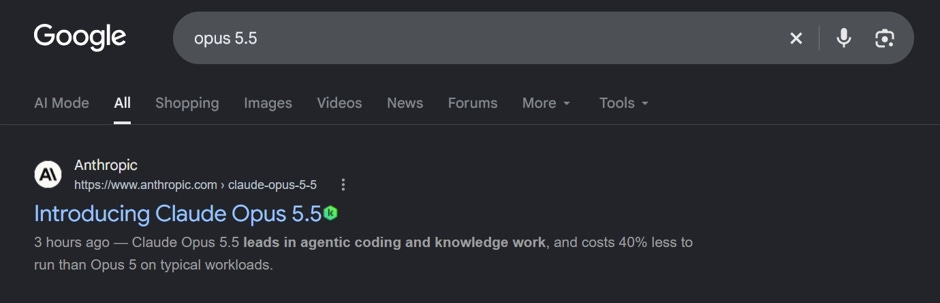
In the announcement of the new model Opus 5.5, Anthropic’s announcement didn’t focus, as is the habit of new model launches, on its mind-blowing capabilities, but rather on the cost, promising a model that provides “comparable performance” to Fable 5.1, while costing 40% less. OpenAI also celebrated the new GPT-6 Sol model’s 50% reduction in cost per million tokens compared to its GPT-5.6 Sol.
The pricing war is likely to escalate, especially on the enterprise front. The aim won’t be only to keep companies from moving to another frontier model, but rather from moving to building their own AI-friendly servers and satisfying their needs with locally-run open-weight models.
However, this pricing war would be hard to navigate with an investor push in the opposite direction of lower training and operational costs and higher revenues.
While the AI industry leaders might be sincere in their push for regulation, development slowdown, and the need for collective effort to counter AI risks, there’s also a strong strategic commercial case to push for more certainty. The industry isn’t necessarily pushing for a better environment, but rather for a more predictable one. Knowing your way out of a rocky mountain is still better than getting lost in a lovely meadow.