

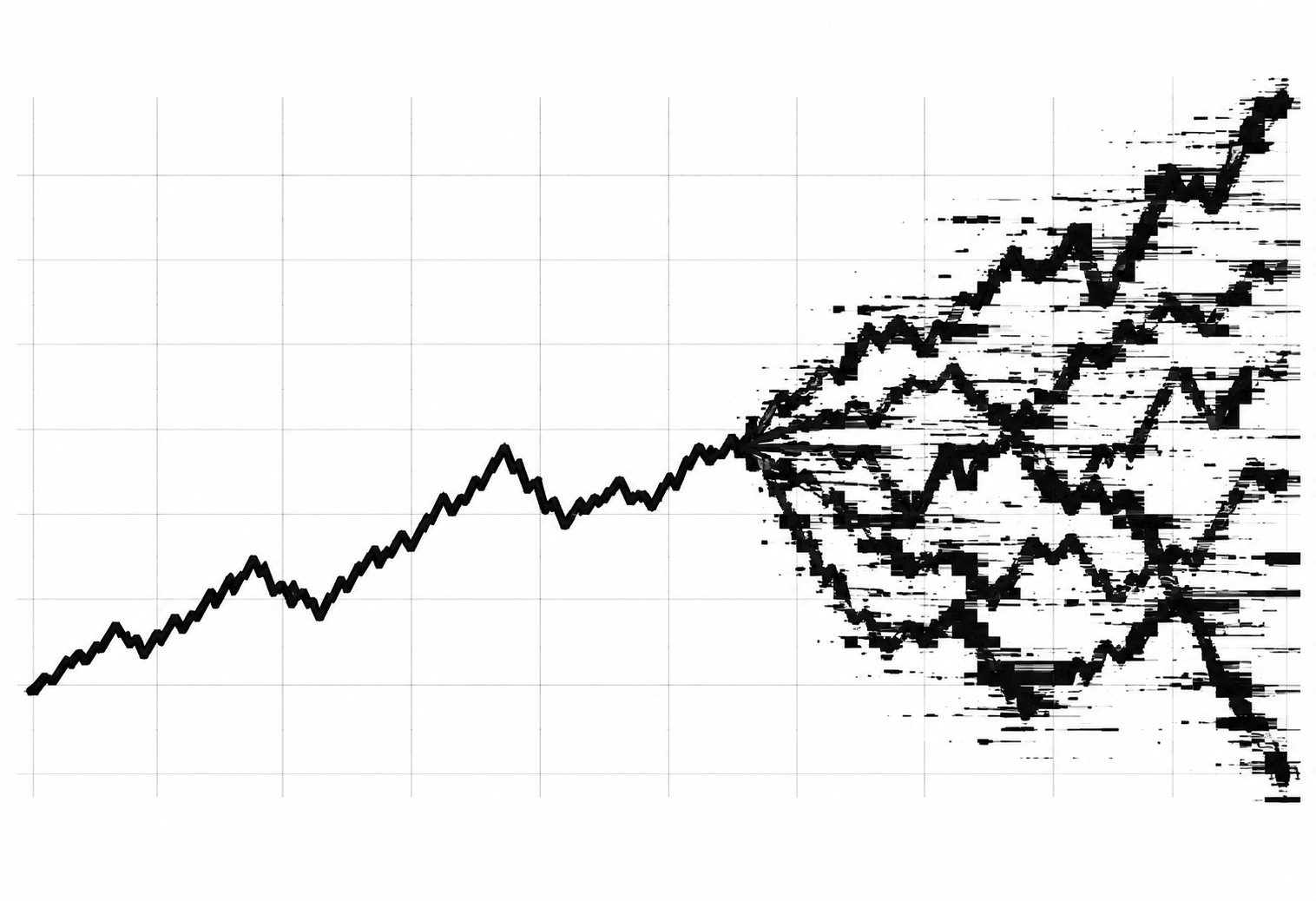
We stand at a weird point right now. AI’s contribution to everything online has gone as far as it can in almost 5 years of widespread use, while legislative and platform regulation hasn’t caught up; neither has our understanding of the hybrid digital reality we’re dealing with.
What we have online now is not a digital twin of humanity. If an alien civilization tries to understand us by looking at our content and systems available online, it will face a digital twin of a complicated blend of human, AI, and hybrid components.
While watermarks somehow help filter out some AI-generated content, the same doesn’t apply to a wider and more influential AI contribution: decisions.
For example, when a user is verifying their identity and address to complete the KYC requirements of a trading broker or a crypto exchange, it’s safe to say that the first round of review of the submitted documents is almost certainly performed by an AI. Single-minute verifications on some platforms suggest that this is the only round. That’s why sometimes we need to upload a different picture or scan that an automated system can read, even if it’s already easy to read by a pair of human eyes.
In this sense, and even though the company approving the account verification still bears responsibility, it’s not clear whether this approval is a human, AI, or hybrid decision.
The same applies to a faster and much more frequent activity: trading.
A thousand bids in an order book don’t necessarily mean a thousand traders willing to buy, but rather a thousand decision processes whose outcome is to buy, whether it’s a newbie’s trust-me-bro moment or an AI agent’s analysis of thousands of data points, including the order book itself.
In his great book Other People’s Money, John Kay provides a great analogy. He starts with a real 1906 experiment that led to the concept of the wisdom of the crowd, where people have to accurately estimate an ox’s weight. Kay extends this to imagine that the scale breaks and the official weight is to be decided by the average of everyone’s guesses, which was actually very close to the truth in the original experiment.
In such a scenario, people would stop trying to guess what the ox’s weight is, but rather what others would guess. This, pretty much, sums up financial markets’ main drivers today, especially that they, in fact, lack a neutral scale to weigh the real value of any given asset.
When traders, especially day and swing traders, place their orders, they’re not estimating the fair logical value of a share or an ounce of gold, but rather trying to get ahead of what they think other market participants’ estimates would be, or even what other participants’ estimates of other participants’ estimates would be. This leads to sentiment playing a big role beyond a clear, coherent equation. P/E ratio incoherence among the largest companies in the world is a good visualization of this chaos. P/E ratio of Nvidia is 28.8, Apple 38.5, Alphabet 17.3, and Tesla 324!
Identifying support and resistance levels is about identifying other participants’ perceptions rather than an asset’s logical value range. The drop after an interest rate decision is mainly driven by expectations of others’ reactions, rather than actual investor reallocation. Examples are endless.
Today, market participants are legally human, but in reality they’re a mix of humans, algorithms, and AI.
High-frequency trading algorithms seem to be on the rise with the advent of AI and how much easier it has made it to build, for instance, an MT5/4 Expert Advisor. Once an institutional advantage, sophisticated trading automation is now a normal tool retail investors and traders can have.
In addition to (ironically now considered) simple coded algorithmic trading, we now have more sophisticated multi-step agents. These are not only reliant on quantitative input, but also parse news, social media content, and other qualitative sources.
Glitching glitches
Anyone who has been long enough in the market knows that the markets sometimes glitch. While mostly rare, it’s not unheard of that a sudden inexplicable spike or drop happens for a short period, and then a correction brings prices back to normal, whatever normal is.
In 2010, the Dow Jones index dropped by over 1,000 points in 10 minutes, erasing 9% of its value, or something around $1 trillion, only to recover most of the losses by the end of the session. This drop was later attributed to the high-frequency trader Navinder Singh Sarao, who allegedly used an automated program to manipulate the market’s high-frequency trading bots to push prices lower.
Reuters’ coverage of the 2015 arrest said that it’s “likely to renew scrutiny of high-frequency and automated trading”. It didn’t.
These kinds of glitches can’t always be attributed to bad actors. An algorithmic loop could cause this in many ways, one of which is what’s known as self-reinforcing volatility, in which algorithm cluster A detects a drop and places sell orders. Algorithm cluster B detects the drop caused by cluster A’s sell orders and places its own sell orders, only for cluster A to detect another drop and trigger more sell orders.
While this kind of loop probably amplifies justified market movements, the original spikes themselves are now more likely to start with misinterpretation of quantitative or qualitative signals, or a qualitative signal disguised as a quantitative signal.
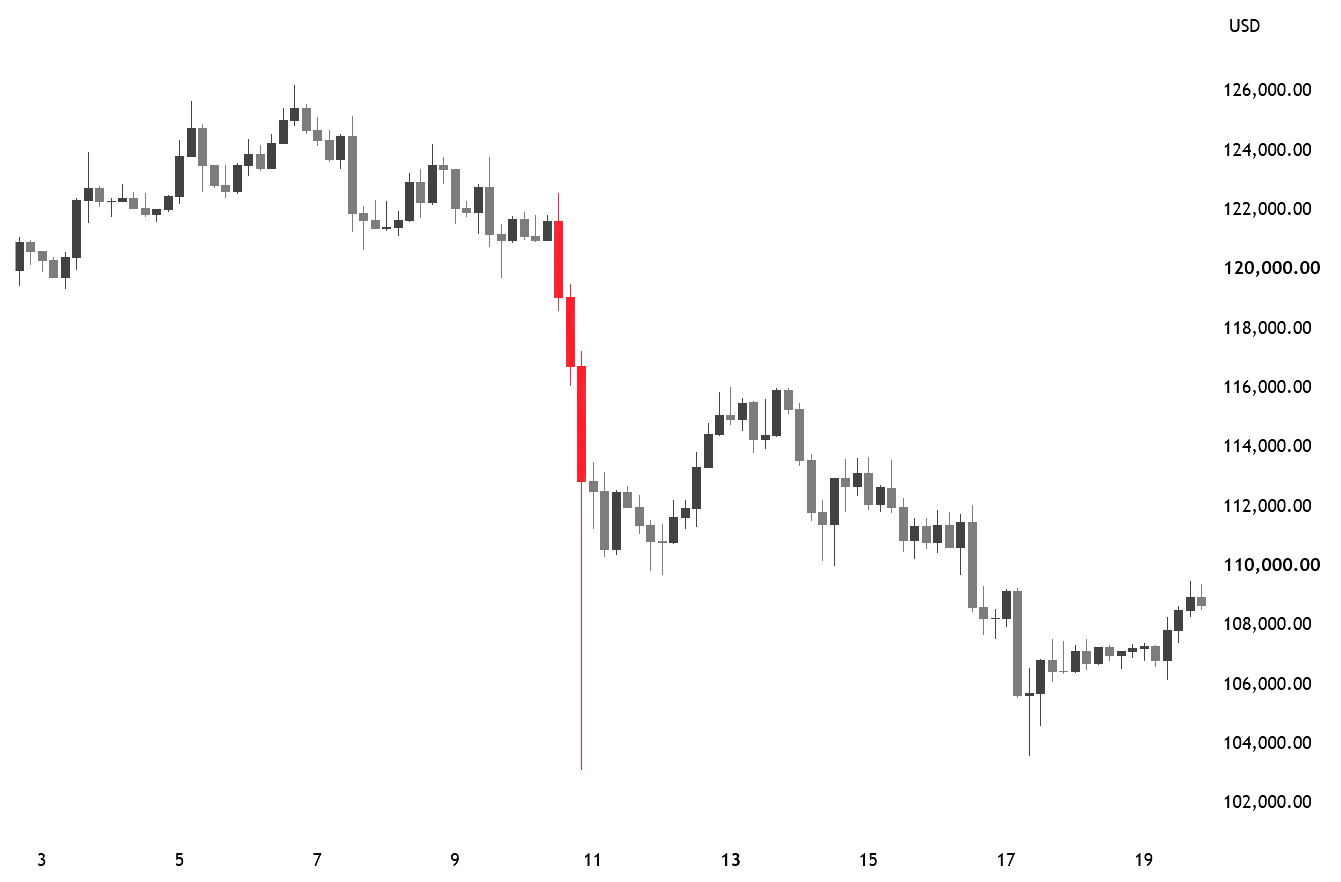
On October 10, 2025, Bitcoin glitched.
Within hours, BTC’s price dropped from as high as $122,500 to as low as $103,000, leading to what was described as the largest liquidation event in the crypto OG’s history, estimated to be as large as $19 billion.
Wait, let me break that down: 19,000,000,000 US dollars worth of trading positions were liquidated in a little less than 12 hours. Reason: a domino effect from Trump’s announcement of a 100% tariff on China. Needless to say, humans can’t possibly panic sell or liquidate their positions that much, that fast.
Generally, crypto traders try to compensate for the lack of fundamental analysis data points, compared to forex and stocks, with several crypto-native data points. One of these is the CMC Crypto Fear and Greed Index, provided by CoinMarketCap.
The index is calculated based on five factors, as per CoinMarketCap’s explainer:
1. Price momentum: Price performance of the top 10 non-stablecoin cryptocurrencies.
2. Volatility: Bitcoin and Ethereum Volmex Implied Volatility Indexes (BVIV and EVIV).
3. Put/Call ratios in the derivatives markets for Bitcoin and Ethereum.
4. Market composition, i.e., Bitcoin-to-stablecoin supply ratio (SSR)
5. CMC Proprietary Data, that’s, according to CoinMarketCap, “social trend keyword searches and user engagement metrics to capture market sentiment, retail interest, and emerging trends.”
Number 5 obviously doesn’t belong. When the index is at 82 (Extreme Greed), it’s because there are more calls than puts, and because more people than usual are posting “Bitcoin! Num num num!”. Many, like many, crypto traders take this index very seriously, especially those with no finance background and technical analysis skills. Somehow, and to some extent, they decide whether they’re timing the market based on the amount of Bitcoin num nums. Even worse, their AI trading agents fall for this loophole in a supposedly quantitative index.
Also, a trader/investor who’s excited for the hike driven—partially at least—by the num nums might express excitement by posting more num nums and driving the index up, supporting a bullish drive that leads to more num nums, by human-run or AI-run social accounts, in an endless loop, or self-induced amplification.
Now add this loop to a much faster, more amplified AI/algorithmic loop, and you get a market on the edge of becoming a meaningless entity, driven by a technology most users don’t fully understand.
Yuval Noah Harari thinks that the highest risk AI poses to the financial system is turning us into cows. Cows don’t understand our financial system; they don’t understand how a check or a CFD works, and many humans share that same level of comprehension when it comes to the non-basic parts of the modern financial markets.
For many of those who were severely affected by the global financial crisis that started in 2008, what actually happened—let alone what caused it—is still a mystery. Something complicated happened in a complicated system and led, in a complicated way, to a job, investment, or property loss.
Harari rings the alarm that allowing AI to manage more segments of the financial system may end up forming a super-complicated financial system that we’d be unable to affect or even understand, though still as influential on our lives as the one some of us can understand and affect today.
So how can we make sure AI’s role in finance, and the world in general, doesn’t turn our economies into slot machines?
Some limits are needed. Something similar to restrictions some brokers place on scalping or stop levels. Something that brings back the role of a slow, justifiable human element, with an actionable segregation between human and machine inputs, making sure the latter is not treated as an input in the first place.
While a lot of the safety measures and regulation discussions to mitigate the risks of AI focus on bad actors, an equivalent focus should be directed toward “accidental” actors, and the ecosystem that enables these accidental actors to cause widespread damage.